Hi, Andréa. Did you send me a gift?
I walked round to the visitors' car park.
Our driveway is still not finished.
And a wee red post van passed me.
He stopped at a house, so when he got out I said,
"Just to let you know I moved in on Wednesday to Number 67;
my brother is Number 69."
"Are you McGuinness?" he asked.
"Yes, I am."
"I have post for you."
I rushed back to my house to see what was in the parcel . . .
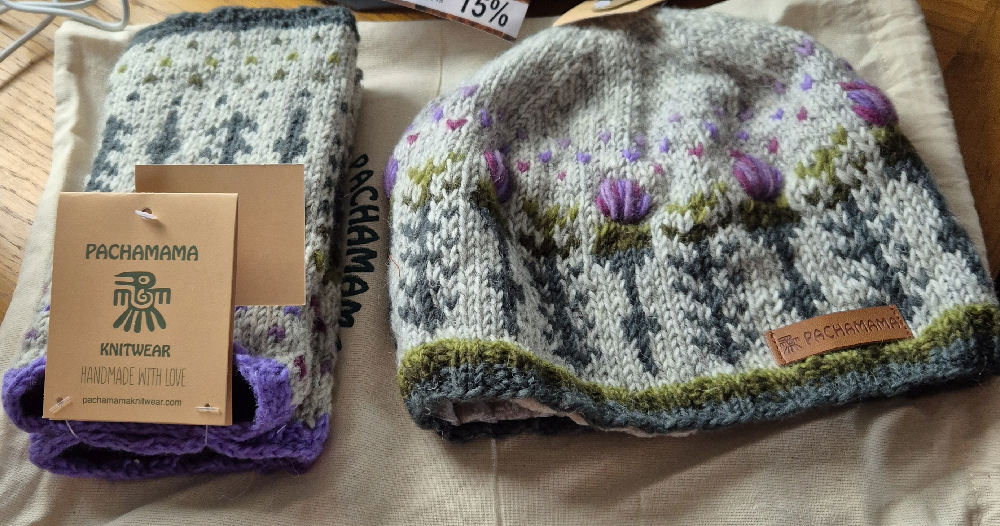
. . . a hat & hand/wrist warmers with thistles on them.
I love them; thank you very much. It's very nice to be spoiled.

Just what I needed. The rain has stopped, but it is very cold.
(There should be another parcel coming next week.)
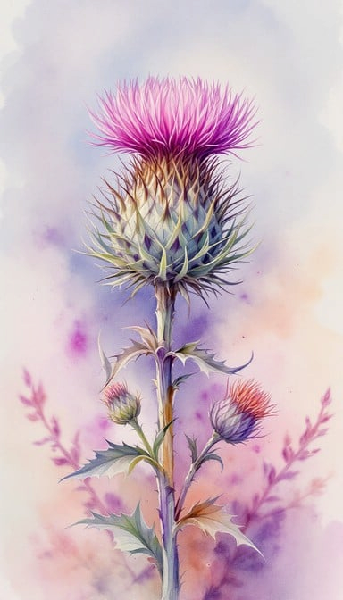
WHY A THISTLE?
The thistle is the national flower of Scotland because of a 13th-century legend
where its spikes alerted Scottish soldiers to a surprise attack by a barefoot
Norse army, saving the country from invasion. This story established the thistle
as a symbol of resilience and protection, leading to its adoption as a national
emblem that represents the nation's spirit and defiant nature.
The Legend: According to the story, which is often associated with the
Battle of Largs in 1263, a group of Norse soldiers tried to attack a sleeping
Scottish army under the cover of darkness. To move silently, they removed
their shoes, but one of the invaders stepped on a thistle. His cry of pain alerted
the Scots, who were then able to fight off the invaders.
A Symbol of Resilience: Following this event, the thistle became a symbol
of Scotland's ability to overcome threats and its resilient spirit.
Its prickly nature, which was the very thing that saved the Scots,
is seen as a metaphor for a protective and defiant nature.
Official Recognition: The thistle has been an official national symbol since
the reign of King Alexander III (1249-1286). It was later incorporated into
national symbols, such as being featured on coins, and also inspired
the creation of Scotland's highest order of chivalry, the Order of the Thistle.
|